The Fish That Died Before It Saw the Fire
9 August 2026
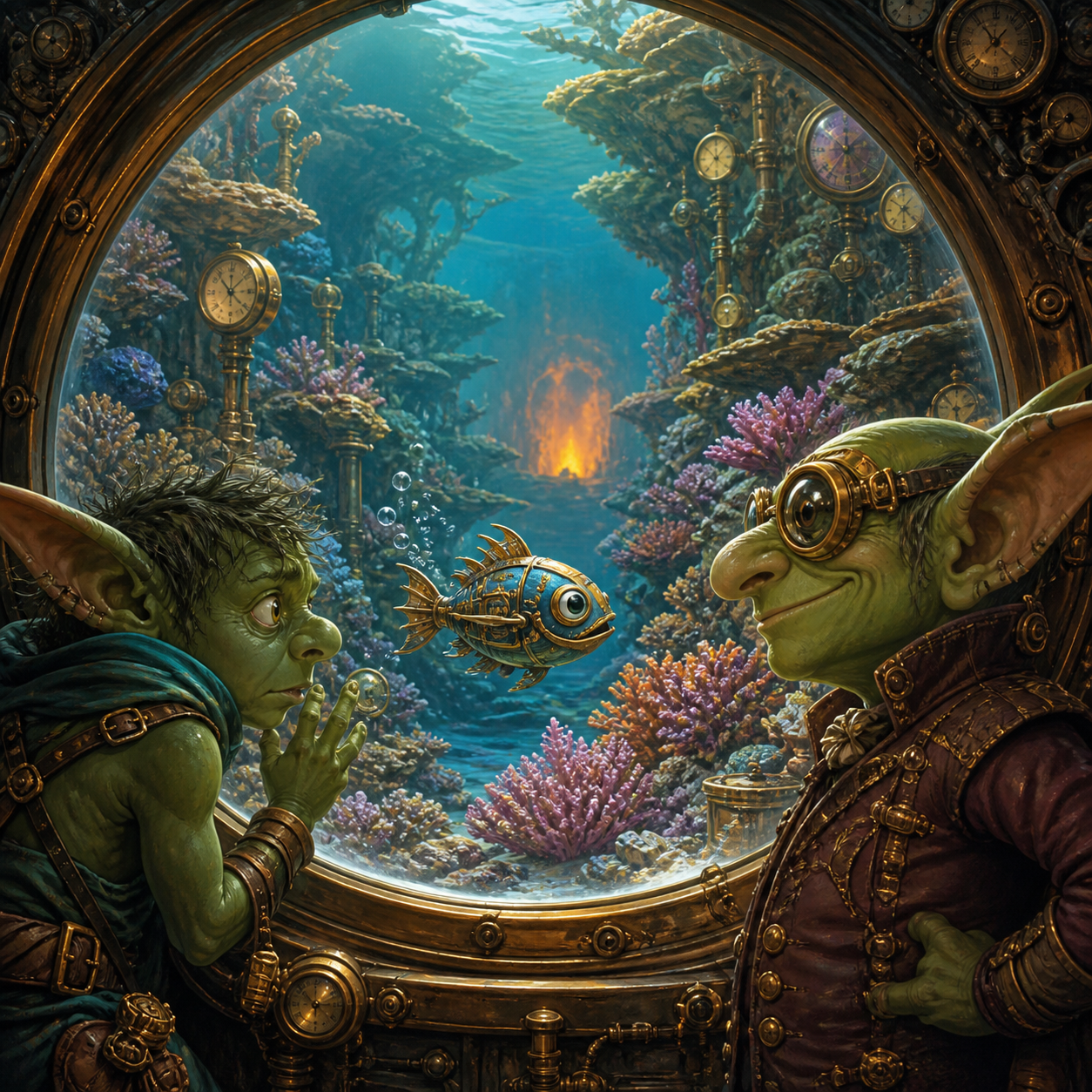
The goblins had built a fishtank.
Not a little testing bowl.
A proper tank.
The widest collection of the creature’s working parts they could safely place together was switched on, the water was busy, the world could change its rules, harms could arrive, memories could form, sleep could come, and the goblins had fitted the glass with more gauges than Refresh Goblin could count without taking his boots off.
“The first fishtank,” said Smith Goblin proudly.
Refresh Goblin pressed his nose against the glass.
The fish moved.
Then it died.
Refresh Goblin blinked.
Another little life began.
The fish moved.
Then it died.
Again.
And again.
Ledger Goblin arrived carrying the autopsy.
“Good news,” he said.
Refresh Goblin turned slowly.
“The fish keeps dying.”
“Yes, but the ledger’s alarm that called the result hollow was wrong.”
“That is your good news?”
“It is accurate good news.”
The autopsy had done its job. It had found a bookkeeping defect: the fishtank reported many channels, but only a few core channels were governed by one combined check that the measurements were genuinely alive. The bookkeeping had mistaken some merely informational quiet channels for failed load-bearing gates and had called a real PASS hollow.
The ruler was repaired.
Four experiments ceased being falsely labelled vacuous.
Ledger Goblin was satisfied.
But the fish still died.
The Builder came to the glass.
He did not begin with the ledger.
He watched.
For a while nobody spoke.
The fish swam through open water.
Its health fell.
It had not struck the hazard.
Its health fell again.
The Builder leaned closer.
“Why is it dying?”
Smith Goblin shuffled through the telemetry.
“The episode ended because health was depleted.”
“I can see that.”
“No direct collision is recorded here.”
“I can see that too.”
Refresh Goblin looked from the numbers to the tank.
“The glass knows something the ledger does not.”
Ledger Goblin frowned.
“Then write down what the glass knows.”
The goblins opened the first fishtank.
Its great promised stretches of six hundred steps were impossible before the fish had even entered the water.
The world itself stopped at five hundred.
“Then why did the sign say six hundred?” asked Refresh Goblin.
“Because nobody asked the world how long its ruler was,” said Ledger Goblin.
They corrected the sign.
Then they found poison in the floorboards.
A slow contamination of the water had been left switched on.
Revisited water slowly became harmful whether or not a hazard had been touched.
“Turn that off in the viewing tank,” said Smith Goblin.
They did.
The fish still died too quickly.
They looked again.
The curriculum itself admitted something awkward: the hazard-avoidance gate had not learned reliably, and the survival gate was failing too. Direct hazard contact was simply too punishing for a showcase whose purpose was to let anyone watch sustained behaviour.
So they softened the collision harm, using an existing precedent rather than inventing a convenient number after the fact.
The fish lived longer.
Much longer in some probes.
But the goblins refused to paint the tank green merely because it had improved.
The gate that asked whether the ecology was survivable was allowed to fail when it failed.
Then the Builder asked for something else.
“Why do you keep replacing the fish?”
Smith Goblin looked offended.
“We reset it between episodes.”
“That is replacing it.”
History Goblin, who had been reading quietly in the corner, looked up.
“Not entirely.”
“No,” said the Builder. “But enough of it.”
They traced what a reset actually did.
Its working picture of the world vanished.
Its inner rhythm vanished.
Its sense of what mattered vanished.
The commitment machinery cleared.
Harm histories cleared.
The fish that appeared in the next segment inherited only selected deeper things.
Thirty episodes were not one long observation.
They were thirty interrupted ones.
So the re-run changed the tank.
The environment could renew around the creature.
Its body could recover.
But its cognitive state would continue across the segment boundaries.
The goblins stopped repeatedly waking a new fish and calling it the same afternoon.
Sleep was made visible on the glass as well.
Terminal causes were finally written down.
More of the hidden state was logged.
The fishtank became not merely prettier, but more scientifically legible.
The re-run entered the water.
The Builder watched again.
The fish swam.
Its health fell.
It had still not touched the hazard.
The Builder pointed immediately.
“There.”
The automated autopsy had not pointed there first.
The run’s record had not explained it.
The moving fish had.
Now the magics went hunting.
They followed health subtraction into the source.
One drain came from collision.
That one had been softened.
One came from contamination.
That one had been turned off.
Then they found the third drain.
It did not require collision at all.
The hazard cast an invisible field across the water.
Merely swimming within that field could hurt the fish.
“How close?” asked Refresh Goblin.
Smith Goblin calculated.
“With the present decay and threshold?”
He looked uncomfortable.
“About eleven squares.”
Refresh Goblin stared at the tank.
“And how far can the fish see?”
Observation Goblin held up the little window.
“About two squares from itself.”
Silence.
“So,” said Refresh Goblin slowly, “the fire can burn it from eleven squares away…”
“…while its ordinary window reaches about two,” said Observation Goblin.
Ledger Goblin wrote one sentence in very large letters:
A WARNING THAT ARRIVES AFTER THE HARM IS NOT A WARNING.
The goblins looked again at the tank they had called an ecology.
There did not merely need to be fewer fires.
There needed to be safe water between them.
And when the fish appeared in a new segment, it needed to appear somewhere safe.
A creature should not begin a trial already inside an invisible injury field and then be blamed for failing to learn avoidance.
“Safe paths,” said Smith Goblin.
“Safe spawn,” said Observation Goblin.
“Close-range warning,” said Ledger Goblin.
“Then test again,” said Refresh Goblin.
But the glass had one more lesson.
Because the re-run’s fish survived long enough to remain itself across a genuinely extended stretch, something that had previously hidden beneath short lives began to grow.
And grow.
And grow.
The residue fields accumulated feeling without any limit and without fading.
The same few places in its memory were revisited again and again.
The creature’s picture of the world swelled far past its proper size.
Excite and dread rose with them.
Smoke tests had never lived long enough to show it.
The short-lived fishtanks had never lived long enough to show it.
Only when the fish was finally allowed to keep swimming did the deeper leak become visible.
Refresh Goblin scratched his head.
“So making the experiment less broken revealed another thing that was broken?”
Ledger Goblin smiled.
“That is often what repair is for.”
At the end of the morning the table was covered in notes.
The first automated autopsy had repaired a false vacuity flag.
The human eye had then noticed that the actual ecology was wrong.
The magics traced that observation into source.
The source revealed three independent ways for the world to drain health.
The redesign demanded safe paths, safe spawning, and a genuinely local warning field.
The logging was found to be incomplete too: a promised episode-log companion had never actually been written, and core run metadata was missing.
And once the fish lived long enough, the longer timescale exposed an unbounded build-up of feeling in the residue that the shorter experiments had concealed.
Refresh Goblin looked through the glass one final time.
“I thought the point of all the automation was that we would not need someone standing here watching fish.”
History Goblin shook his head.
“The point was never to remove every kind of seeing.”
Observation Goblin nodded.
“A ledger sees structure.”
“An autopsy sees inconsistency.”
“Source inspection sees mechanism.”
“And eyes…”
He pointed at the fish.
“…sometimes see that the world itself is absurd.”
Ledger Goblin closed the book.
“Then the proper loop is not human or magic.”
He wrote:
LOOK → QUESTION → AUTOPSY → SOURCE → REDESIGN → LOOK AGAIN
Refresh Goblin grinned.
“The glass is part of the laboratory.”
“Yes,” said Ledger Goblin.
“And now we have evidence for that too.”
Chronicle note
This chronicle reconstructs the Fishtank episode of 8–9 August 2026 (the first fishtank and its re-run) from the project’s records.
The first fishtank was a claim-free, full-stack observational showcase intended to expose the current integrated REE-v3 creature to a long, rich environment. Its automated failure autopsy correctly identified a false “hollow pass” verdict caused by a bookkeeping mismatch, but that was not the important ecological problem later visible in the rendered behaviour.
Direct visual inspection of the fishtank showed that realised episodes were too short to display sustained behaviour. Source investigation for the re-run found that the promised episode length was impossible because the environment capped episodes shorter; a contamination setting could drain health on revisited cells; and the full-stack creature’s hazard-avoidance/survival competence was poor enough that direct hazard harm also curtailed observation. The re-run’s redesign therefore corrected the reachable budget, disabled contamination in the observational environment, relaxed direct hazard harm for showcase legibility, made the evaluation a continuous multi-segment observation of the same cognitive agent rather than repeated full cognitive resets, exposed sleep events, and expanded telemetry.
Visual inspection of the re-run then supplied the decisive new clue: health fell rapidly even when the fish did not visibly contact a hazard. The subsequent autopsy traced a third independent health-drain path in the environment code: proximity-approach damage. As configured, the field remained damaging to roughly eleven cells from a hazard, while the learner could see only about two cells around itself; this made harm possible well before the hazard could become a local perceptual warning. The resulting redesign requirements included genuinely close-range proximity harm, substantial safe space, safe paths, and safe spawn positions outside hazard-field influence.
The same investigation found recording defects (including a promised companion episode log that was not actually written, and missing core run information) and, because the continuous fishtank finally sustained longer exposure, exposed a separate substrate issue: the residue layer accumulated valence with no bound and no decay, so that the creature’s internal picture of the world and its excite and dread signals grew very large. (The welfare consequences of this, and what changed, are told in What We Got Wrong.)
The historical significance is the epistemic loop itself: human visual observation generated a hypothesis that the automated autopsy had not generated; AI-assisted autopsy and source inspection localized the mechanism; the source-level diagnosis then produced a more valid experiment. The lesson is complementary instrumentation, not human superiority over automation or vice versa.
The experiment and claim records behind this Chronicle are kept in the project’s private record.